Showing posts with label Animal Nepal. Show all posts

Friday, January 28, 2011

Animal Nepal honours ‘clean and green’ brick producer


Kathmandu, January 27, 2011 – Animal Nepal today honoured Mr Indra Tuladhar from Bungamati Itha Udyog for producing ‘clean and green’ bricks using Chinese technology. The animal welfare organization urges other brick producers to follow the example and eliminate environmental pollution as well as the exploitation of working children and equines. “The industry has the technology and the resources to stop the production of ‘blood bricks’; all it needs is the right kind of motivation,” said Krishna Singh, programme manager at Animal Nepal.

Animal Nepal’s gesture is supported by Dutch Party for the Animals member Martin Schoenmakers. Together with Animal Nepal Volunteer Director Lucia de Vries he offered a certificate and gifts to the clean bricks producer.  

The Bungamati brick factory in 2019 introduced Chinese automated brick making machinery. Instead of being seasonal the factory now produces bricks all year round and no longer employs migrant workers, children and donkeys. The bricks are transported by electric carts. Although the process is not yet completely environmentally friendly, there is a great reduction in emissions. Bungamati Itha Udyog is one of the three factories in Nepal using this technology.

Enterpreneur Tuladhar was motivated to clean up his factory when learning about the new technology. He says the brick industry suffers from labour problems, animal abuse and environmental pollution. The contracted workers at the improved kiln earn a fixed salary and no longer face hazardous work conditions.

Animal Nepal since 2008 reaches out to around 500 equines (mostly donkeys) working in brick kilns in Kathmandu Valley. There is relentless pressure to over-work and overload animals. Life expectancy for these animals is short and most donkeys suffer from serious health conditions problems.


In order to help make buyers make the rights choices, a network of NGOs active in environmental protection, children’s rights and animal welfare, including Animal Nepal, have joined hands to promote a responsible brick-making industry. They are introducing a certification system that will provide brick factories with a red, orange or green label.

Animal Nepal urges the brick industry to clean up its act and stop the production of ‘blood bricks’. “Brick kilns are the number one polluters in the Valley and employ countless children and donkeys to do the dirty work. Both issues can be addressed by introducing new technologies such as Vertical Shaft Brick Kilns or automated machinery,” says Krishna Singh. 

Saturday, December 11, 2010

Animal Nepal exposes illegal puppy trade to India; rescues 42 puppies


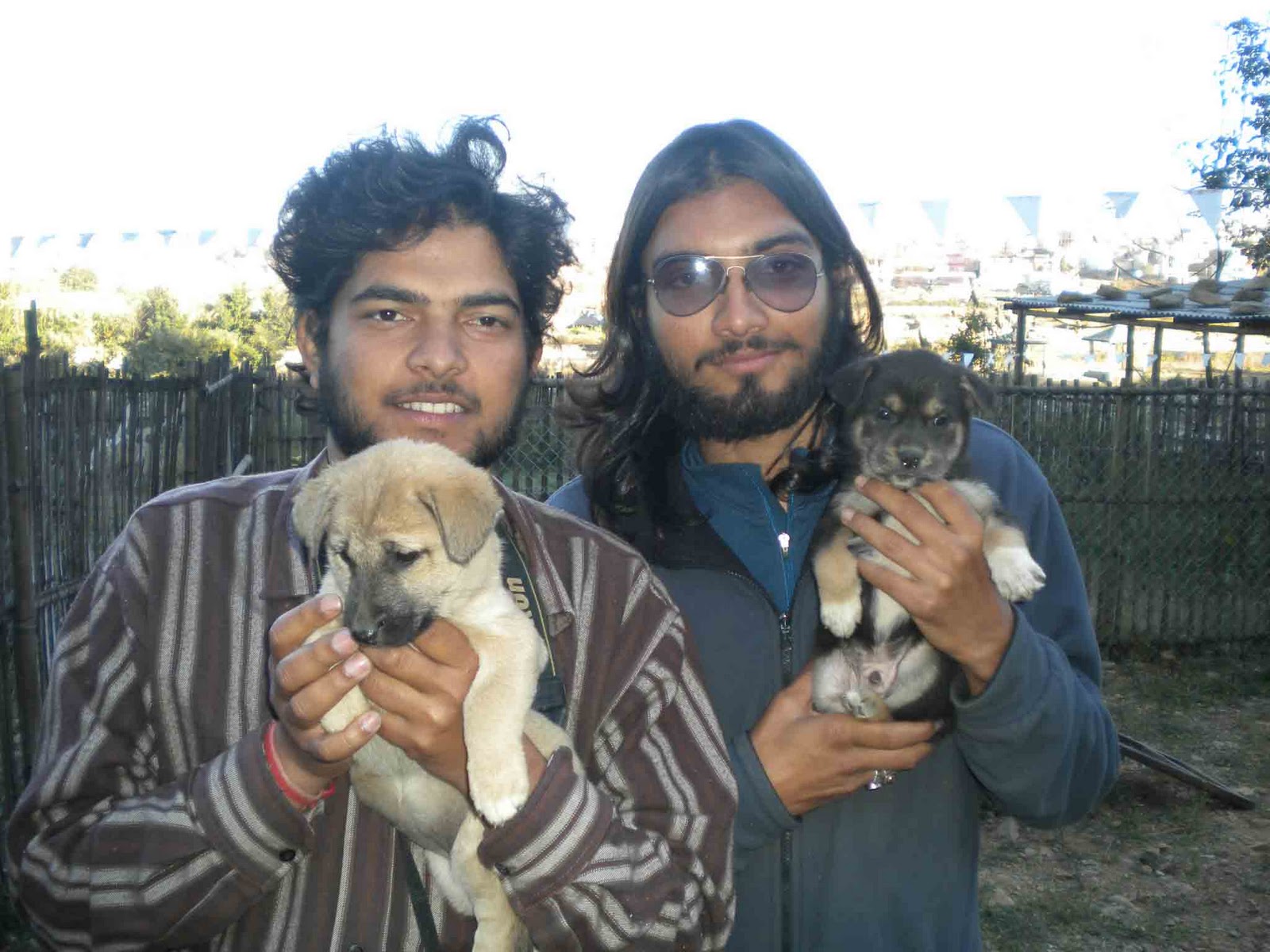
Kathmandu, December 10, 2010 – Thousands of Nepalese stray puppies have been sold as ‘Himalayan breeds’ in India in the past decade. This was found when Animal Nepal and Roots and Shoots exposed the illegal trafficking of Nepalese dogs to India by rescuing 42 puppies last night. The puppies were destined for Sonepur Mela, Asia’s largest animal fair, held annually in Bihar. The organisations call for stricter law enforcement and request Nepalese families to come to the rescue by adopting one the puppies.
Animal welfare groups for some time suspected that illegal trafficking of Nepalese puppies to India was going on but were unable to expose the trade. Traders collect stray puppies from the streets of Kathmandu, Lalitpur and Bhaktapur districts and promote them as special Himalayan breeds in India. It is estimated that in the past decade thousands of mixed breed dogs have been sold as pure breeds across the border. Exporting any life animal without official documents is illegal under Nepalese law.

Indian traders Mohammed Sagir, Aka Kallu Miya, Mohammed Ali and Mohammed Nasin, when reporting at the police, said that in the past years they were never asked any questions by Nepalese or Indian authorities. Some of the traders were arrested for bird smuggling in the past but were released as the police deemed the confiscated bird species not important enough for prosecution.

The puppies are cramped in mesh wire cages and transported on top of public buses from Kathmandu to Sonepur in Bihar via Malangala in Siraha. “The puppy trafficking, apart from being illegal, is an extremely cruel business. The majority of puppies are no longer alive when the consignment arrives in Sonepur. They die due to cold, weakness and a lack of food. Most puppies are not properly weaned and don’t stand a chance in the first place,” says Manoj Gautam from Roots and Shoots Nepal.

Last night 37 puppies were rescued from a bus ready to depart from Kalanki bus station while five more were taken from the traders'. They are presently being treated at Animal Nepal’s Chobar Sanctuary.  According to Managing Veterinarian Dr Surendra Basyal the condition of the puppies is appalling. “Some of the puppies are not properly weaned. Some are as young as three weeks. When we opened the jute covered cages the puppies were totally wet from sweating. One was squeezed to death while three died overnight. I cannot imagine that any of them would have survived the long journey to Sonepur.”

The puppies will have to be monitored and hand fed for at least four weeks. Animal Nepal says volunteers will be needed to help out with the care.

Volunteer directors Pramada Shah and Lucia de Vries request the public to come to the rescue by adopting a puppy. “The popularity of Nepalese stray puppies in India shows that Nepal’s mixed breeds are as handsome as any pure breed,” they argue.

Roots and Shoots in the past has exposed the growing bird trade in the region, including the trafficking of protected owl species. “The Nepalese dog export in fact funds international bird trafficking. Traders use the stable income from dog sales to buy protected, rare birds and embark on riskier forms of trafficking,” says Manoj Gautam.

Nepal is one of the few countries in the world without an animal welfare law. The breeding and selling of companion animals goes unmonitored and is conducted mostly by unregistered companies.

The Sonepur Mela of Bihar is organized every year in the Hindu month of Kartik (November/December). Indian welfare campaigners have their long voiced concerns about the fair. India’s Environment and Forests Minister Jairam Ramesh recently expressed doubts about the future of the disputed fair. 

Friday, November 5, 2010

Xena's new leash on life


Margaret and Laurence Becker from Australia during their stay in Nepal rescued countless dogs. In some cases Animal Nepal was able to assist them with vet or transport services. One such case was that of Xena, a malnourished, limping puppy who blossomed into a beautiful, healthy adult. This is what Margaret and Laurence write:

"Xena came to our attention when a friend noticed that the three moth old stray pup's ears living not so far from our house looked somehow different. Upon closer inspection she realised that Xena was covered in ticks. In addition she had wounds on her back legs and she limped indicating a vehicle accident at some stage. Given that this puppy was born in a very busy area we decided to call her Xena because she had thus far survived the odds and was still alive! The name comes from the TV series about a female warrior princess. Xena definitely is a feisty girl, a survivor!

Xena had her first trip in a taxi to he Mobile Vet Clinic at Jawalakhel where she was treated for ticks. What a relief for her! I then contacted Lucia at Animal Nepal who suggested we take Xena to the Chobar Sanctuary for spaying and vaccinations. This was Xena's second ride in a taxi where she happily curled up on the floor at my feet and slept for the journey!

Five days later I received a call from Animal Nepal to say that Xena would be arriving that evening at Patan Dhoka. Laurence and I waited excitedly for the jeep to arrive and when it did Xena jumped out from the back and ran into our arms. This reunion certainly attracted a crowd!

We are pleased to report that Xena has been accepted by the locals and that she is well fed. She is also part of the large dog community at Patan Dhoka and is often seen playing with other pups. 

She certainly knows her name and comes running when we call her. She has a beautiful nature and is very loving and it is a joy to see her whenever we are at Patan Dhoka.

Thanks to Animal Nepal Xena has been given the chance of a rabies-free life and will never have the burden of puppies.

We wish her a safe and happy life."

Wednesday, August 18, 2010

Animal Nepal reaches out to scavenger donkeys in Nepalgunj


After having worked with some five hundred donkeys in brick kilns since December 2008, there is still so much we do not know about the conditions of working equines in Nepal. New facts and figures continue to shock us. 


In the Summer of 2009 we discovered something very unsettling. Until then we believed the owners of the equines when they said that, yes, their animals had to work hard under very harsh conditions when the brick kilns were running, but that after six months they would return to the hometown of the owners, Nepalgunj . The period May-December would be R&R time for the much abused animals. We believed them. I personally had a vision of donkeys standing under a thatch roof, chewing on fresh grass, nursing their aching bones.


The reality was a less prosaic one. When in May programme manager Krishna and vet Sudeep arrived in Nepalgunj in western Nepal at night, they were shocked to see donkeys on every street corner, rummaging through piles of rubbish. “Why are these donkeys outside on the street in the middle of the night?” they asked the taxi driver. “Oh, that’s where they live. The owners have no land so they abandon them on the street or in the jungle,” the driver remarked casually. 


These hardworking equines abandoned after slaving for their owners for six months in brick kilns in far away Kathmandu? Left to fend for themselves without being provided with any food and water? No place to hide from the sun and rain? And all that in the hottest city of the Nepali plains, where it gets as hot as 45 degrees Celsius?

In the following days Krishna and Sudeep saw donkeys giving birth on busy intersections, equines so malnourished they could hardly stand on their feet, and even blind ones bumping into cars and bikes. All of them searching for food and water; many of them were scolded and beaten by shopkeepers.

We gritted our teeth and as a first step published a report on the abuse of working equines in Nepalgunj. You can read the ‘Beasts of Burden’ report on our website under Reports and Docs. We then developed a petition called ‘Stop Donkey Misery in Nepal’ and collected over 1000 signatures. The plea was handed over to the Joint Secretary at the Ministry for Agriculture and Cooperatives.

It was a dream come true when on June 5, 2010 we were able to launch our Nepalgunj Outreach Programme with the support of Donkey Sanctuary UK and India. Krishna and Sudeep again spend two weeks in western Nepal to hire and train local staff and to introduce the programme among local authorities and media. The programme, supported by Donkey Sanctuary UK, started by organizing a press meet to inform the local media about the terrible conditions of equines in their city. The second step was an interaction meeting with the owners of the donkeys, discussing problems and solutions.

Specific objectives of the programme are to stop illegal import of unsuitable equines into Nepal, to improve health conditions of working equines with help of authorities, to improve economic conditions of owners and children, to increase awareness on working equine problems in the local community and to create exposure of the issue in the media.
We have hired a part time local vet, Prativa Shrestha, to treat sick and injured donkeys and to connect the owners to the government veterinary health system. We also hired Surendra Karki as a part time campaigner. He will be responsible for activating the authorities to register the animals, to build shelters, to improve quarantine services and to improve the economic conditions of the equine owners. 


Donkey Sanctuary India has promised to help us changing the habits of owners when buying new donkeys in India. Instead of buying the cheapest, weak equines, we will pressurize owners to buy healthy, strong horses and donkeys.

It is hard to be patient when faced with such a widespread form of animal cruelty. At times we feel like suing all donkey owners for gross violations. But if we want to improve conditions for the hundreds of ‘brick donkeys’ for good, at all levels, we have to work in a less aggressive, systematic manner.

For the time being it’s one donkey at a time until all working equines in Nepal are treated with respect.

Saturday, July 24, 2010

Mission (im)possible


“Our children are much less scared of dogs.”
“It is such a relief not to have all these puppies walking on the streets!”
“Please help the dogs to get rid of their skin problems!”
“Can I get my dog spayed too?”

These are some of the comments we got from local communities after we introduced our pilot Animal Birth Control/Anti Rabies (ABC/AR) programme. We called the programme ‘Patan Rescue” because it felt like a rescue mission. With over 35,000 stray dogs in the urban areas of Kathmandu Valley alone, and the majority of them suffering from malnutrition and disease such as skin problems, open sores, tumours, birthing complications and –last but not least- much feared rabies, our mission to create a smaller, healthier dog population seemed Mission Impossible.

With the help of a grant from HSI US and a matching grant from HSI Australia, we felt secure enough to take the first important steps: building a rehabilitation center, training our vets in spaying techniques and buy an ambulance. The local forest committee of Chobar, a beautiful historical village build on a hill on the outskirts of Kathmandu Valley, provided us with a plot of land. An architect friend designed an office building with operation theatre made entirely from renewable materials: unfired mud bricks, to be covered with cow dung.

Training our staff was a tough one, as virtually no vet in Nepal knows how to conduct the preferred sterilisation method, flank spaying. We were helped by the Kathmandu Animal Treatment Center (KAT) whose vets were trained by Help in Suffering India.

Our happiness knew no bounds when a grant from 30 Million d’Amis (France) enabled us to buy a Maruti Gypsy car, acting as Kathmandu’s first animal ambulance.

Even before the center was completed sick and injured dogs were dropped at our premises. Among the first residents was Toffee, a blind Labrador, abandoned by his owner. He was a handful in the beginning but once Toffee understood the parameters he became a very affectionate dog. A few months later Toffee was adopted by Volunteer Director Pramada Shah and travels with her wherever she goes. He regularly visits our office and his old home at the Chobar shelter!

Another early patient was Marky. Terrible malnourished, Marky suffered from rickets and a bone disorder. His condition is a painful one and apart from providing with nutritious food there was little we could do to ease his discomfort. Marky became close friends with Dutch volunteer Aicha Boele, who decided to take him to Holland. There he will receive physiotherapy and specialised care to ease his discomfort.

Yet another suffering creature staying at Chobar was Namuma, a hairless, extremely weak puppy. Namuna turned out to be a great character who loved to be cuddled but at the same time proved to be a good guard dog. When his hair grew back Namuna developed a shiny black coat with dots on his belly. An elderly lady adopted him; he now guards a large compound while keeping his ‘mummy’ company.

On October 17 we celebrated Kukur Tihar, or national dog worship day, by officially opening the Chobar Animal Sanctuary. In the next two months time 35 dogs were treated and rehabilitated. On December 28 our vets Surendra and Sudeep spayed and vaccinated the first batch of stray dogs. On April 13 we spayed and vaccinated Putali, a lovely black dog from Taudaha village, the 100th dog.

By now we feel confident that we can make a lasting change in the situation of stray dogs in Kathmandu Valley. We have launched a 2-year programme called “Kathmandu Rescue” in which we hope to treat and/or spay and vaccinate 1250 dogs. We also hope to educate and work closely together with the different communities from where the dogs are taken. The two municipalities involved will gradually increase its involvement by providing staff and finances. We will teach children in local schools about animal welfare and encourage them to be involved.

Making a lasting difference means we need to prepare the next generation. They need to develop a different relationship with stray dogs. Not one based on fear, but based on trust, love and care. We are set to make it happen!

Lucia de Vries
Volunteer Director Animal Nepal

Donkey in the back


Night was falling when I drove Animal Nepal’s rickety ambulance towards the Donkey Sanctuary. A man on a motorbike passed the car and looked inside. His face froze; he decreased his speed. Soon he drove along the ambulance, glancing inside.

The man was not eve teasing. He was looking at the patient in the back of the car, an adult white donkey, positioned rather uncomfortable in the tiny car. The donkey’s head partly stuck outside the window, her nostrils flaring. Once in a while she tried to reach me with her nose, as if to say, ‘please take me out of here.’

That morning Animal Nepal’s three vets, Sudeep, Surendra and Parisha, and myself drove to a remote brick factory in the Kathmandu Valley. The ambulance had trouble getting there; we had to cross streams, and navigate around boulders and bricks, apparently fallen off trucks. The kiln was located in a beautiful spot, on the shores of the Bagmati river, amidst fields covered in flowering bright yellow mustard, dotted with traditional mud houses. A scene from a tourist postcard.

However, when we parked the car inside the factory a very different picture emerged. Children dressed in rags, carrying younger siblings on their back, surrounded the ambulance. Their faces were covered in dust; some of the toddlers’ heads were shaven to prevent lice. There were no adults around; while the parents worked the children had to take of themselves and each other. None of the children had any toys. A boy wearing a dirty Nepali topi[1] pulled a wooden brick mold behind him through the dust.

We had to walk up a hill to find what we came for. The open air factory employs some fifty donkeys, mules and horses to carry unfired mud bricks from a hilltop down to the kiln where they are baked. Today we brought a first aid box and planned to teach the donkey owners (four in total) how to use the medicines.

The owners in this particular factory are cooperative, and often call us when a donkey is sick. Still, we were shocked by the conditions of the animals. They were overloaded and continuously beaten by wiry handlers, boys from poor families, as young as eleven.

The vets immediately started treating the animals. Apart from saddle wounds the donkeys and mules suffered from hoof problems and eye infections. One severely malnourished mule stood alone, too weak to move. “Minimum one week rest and mineral supplements twice a day,” adviced Sudeep, after providing the poor creature with a medicine to promote digestion. A mule suffering from laminitis, a very painful condition caused by inflammation of the hoof, was given two weeks rest.

“Please have a look at one of my new donkeys,” one owner requested, “she is blind and her back legs don’t work properly.” We walked over to the night shelter and found a pathetic looking donkey, lying on the path. The creature was dehydrated and malnourished, and seemed unable to walk. The vets became agitated. “Why did you not call us earlier? We won’t allow you to keep this donkey here in these conditions,” they told the owner.

A long debate started, in which the owners explained that someone took the donkey here from another kiln, and that, yes, he was agree to send the animal to our sanctuary. What’s more, he and his friend would personally carry her to the car.

That was how Shree Devi, as the donkey was named, ended up in the back of our ambulance.
Shree Devi at first was apprehensive. After the long, bumpy ride to Godavari, we had to literally pull her to her retirement home, supporting her back legs.

After her arrival the twelve other resident donkeys left the night shelter to sniff at Shree Devi. She easily passed the test. Then she enjoyed the first of many nourishing meals in her new home.

Animal Aid Abroad in 2010 supports Animal Nepal’s working donkey outreach programme and sanctuary for the second year. We support some 500 donkeys in ten brick kilns and hope to expand our programme to more brick factories later this year. Donkey and kiln owners claim that thanks to our work the conditions of donkeys have greatly improved. They say that the loads are smaller, that beating has decreased, and that the general health conditions of the animals are far better than before.

To some extent this is true – inputs such as regular de-worming and vaccinations, first aid boxes, improved harnesses, hoof cleaners, health camps and educational workshops have had a visible impact. Recently three new staff have been recruited to intensify our support services and emergency shelters are being constructed in key brick factories.
However, we still occasionally come across abused and injured donkeys such as Shree Devi. Next time when we visit a brick kiln we hope to leave empty handed…

Lucia de Vries
Volunteer Director Animal Nepal

Monday, April 13, 2009

Putting a Smile on your Face

The thousands of children who live in work in brick kilns in Kathmandu District during the brick season (December-June) have little reason to smile. They come from the poorest districts of Nepal, or Bihar in India. Some come individually as bonded labourers whose parents have been provided with a small advance. They work as donkey handlers or brick carriers. Others come with their parents, labourers who try to pay off debts to the local middleman, and mold bricks out of clay.


While in Kathmandu the children don't go to school, live in makeshift shelters, and spend their days working in dangerous and unhealthy conditions.


Animal Nepal has allocated one model brick kiln in Bungamati where it will establish a daycare centre for children below 5, and admit children between 5-12 at a local school. If the project is successful it will be replicated in all the ten brick kilns where we work.

When a group of Dutch friends heard about this inititiative they quickly organised a donation drive. Within a week they raised no less than 830 euro! They also collected almost 50 (second hand) t-shirts for the brick kids.
Coordinator Judith de Vries personally handed over the money and t-shirts at the Bungamati Brick Kiln. She had some trouble identifying who were boys and who were girls but eventually all the children were dressed in a bright t-shirt. The parents expressed their appreciation. 'We really want our children to go to school but the older ones have to look after the babies, and we can't afford to buy uniforms and notebooks for them,' they said. Once a daycare facility has been established for the young kids the older ones will be released from work and admitted at school.

We want to thank all you generous donors out there!


Thursday, March 12, 2009

Donkeys of different sorts


This week we officially launched our donkey clinics at the brick kilns in Lalitpur district. Dr Sudip Koirala, together with social workers Uma Limbu and Krishna Singh, coordinated a visit to Bungamati brick factory, which we will develop into a model brick kiln. Here over 500 workers live in makeshift sheds in an area as big as a large village. Most of them are Terai Dalits or come from other marginalised groups. They are the poorest of the poor: they don't own land, often don't have citizenship papers, are illiterate, and basically constitute the large chunk of forgotten people of Nepal.

Among them children, many children. There are babies who rummage through the unfired bricks. And there are children who look after their siblings and carry bricks as soon as they can walk. Our heart goes out to them. No chance to be educated, no opportunity to create a better life than that of their parents. Many are malnourished - the worst start a child can have in life.

Our heart also goes out to the working donkeys. At the Bungamati kiln there are 95 of them, plus a few dozen handlers, all kids from poor families in India or Terai. The handlers are far from home and work hard to bring home a few thousand rupees when they return home in May. One wonders who are worse off: the handlers or the donkeys, of whom 80% suffers from infections, injuries and/or malnutrition and dehydration. They are overloaded, beaten mercilessly and when injured left to fend for themselves.

Animal Nepal can no longer watch the suffering. Even though funding has not yet been secured we have launched an outreach programme for both brick kids and donkeys. Have a look at the documentary on www.animalnepal.org/adoptadonkey.html

All in all there are around 400 kids and 500 donkeys working their heart out in ten brick kilns in our district. We want the kids to be happy, healthy and educated. We want the donkeys to be healthy and well treated. Is this a dream that can't come true? I don't think so. Already, with the help of individual donations and the support of colleague organisations (SPCAN, KAT) and many volunteers we have provided basic health care to almost 500 donkeys. Some 50 children received a colourful t-shirt and will soon go to school. This week we have taken the next step to make our dream come true.

Your help us very much appreciated.

Sunday, September 21, 2008

Mangal and the crime that cannot be forgotten

Animal rescue can be a depressing thing. Yesterday we were called by a young woman from Mangal Bazaar, Patan. A dog needed to be rescued. When we arrived in the alleyway where the dog was kept we were greeted by a dreadful smell. The smell of a suffering, dying dog. A shivering dog was lying in a dark corner, a part of its flank cut off and the underlying flesh and bone parts exposed. Someone must have attacked it with a sharp knife. It barely looked at us, but allowed us to stroke its sad, wet face.

At first people were willing to help. A taxi was called and we were informed that it was no good calling the owners, since they couldn't care less. But when it came to lifting the dog unto a plastic sheet only a drunk neighbour came forward.

At the Mobile Vet Clinic the dog was immediately provided with anesthesia. Soon it became apparent that the dog also suffered injuries on one of its legs and on its back. We decided to put it to sleep.

We did not want the dog to die nameless. We called the dog Mangal, after the location where we found him. Mangal will remain a symbol for the level of cruelty that is inflicted on animals in Nepal.

Rescues such as these make us feel intensily sad. But they also remind us of how important our work is. Until recently no one knew what to do when dogs were tortured. Now people know whom to call. They are angry and upset; the lady who called us said the dog was one of her favourites, who often visited her shop. Mangal went through tremendous suffering but at least he died a painless death.

The next step is to get the Animal Welfare Act passed and functioning and bring the perpetrators to book.

I hope Mangal did not die in vain.

Friday, April 25, 2008

Donkey Woes


The conditions of the working donkeys of Kathmandu Valley are as dark as those of the children who work there. It is believed 60,000 Nepalese children make a living by making bricks. No one knows how many donkeys are made to carry bricks all day, bearing loads above their capacity.

I reviewed a brick kiln in Siddhipur and was shocked, both with the conditions of human workers and the donkeys. Wounds go untreated, severy ill donkeys are left to die, and some even have their ears cut in childhood. No vet ever visits these places. All donkeys looked depressed.

The same week, a pair of donkeys was left to die at Kushunti, Patan. One survived and was called Asi, Hope. The Kathmandu Animal Treatment Centre kindlyrescued the surviving donkey after local children informed them. Thank you KAT and thank you children!

KAT's founder Jan Salter says in an interview: “The brick factories destroy the surrounding vegetation so there is very little for the donkeys to eat. It appears that they are just forced to work until they drop. We need to educate the factory owners and workers in the care of these long suffering animals in the future. We hope that ‘Asi’ will become a symbol for the future wellbeing of all suffering working animals in Nepal.”

This silent suffering should be addressed. It's time for all of us to ACT!